
Aquaculture has grown rapidly in India; this expanding sector is key to food security, providing jobs and generating income for rural areas. The fish farming industry is becoming more commercialised with advances in technology. Therefore, selecting the right type of fish feed is very important. The question of whether to use floating or sinking fish feed (the two most common types) is one of the most frequent concerns for fish producers today.
The way fish are fed has a direct effect on the rate at which they grow, the amount of feed used, the quality of water in their environment, how healthy they are, and ultimately, how profitable the farm is. As a respected fish feed manufacturer in India, Happy Feeds realises that farmers who understand how to make sense of all this information will be able to make profitable decisions. Therefore, this blog will provide an overview of floating versus sinking fish feed, including their relative advantages and disadvantages, and which type of feed works best under the conditions in Indian aquaculture.
Understanding Fish Feed in Aquaculture
Fish feed consists of more than simply feeding fish! Fish Feed is essentially a precise blend of proteins, fats, carbohydrates, vitamins and minerals. The ideal fish feed will contribute to:
• Increased Rate of Growth
• Strengthened Immune System
• Improve digestion
• Decrease Mortality
In Aquaculture in India, there are typically two types of fish feeds:
1. Floating Fish Feed
2. Sinking Fish feed
Let’s understand the two Types of Fish Feed:
What is Floating Fish Feed?
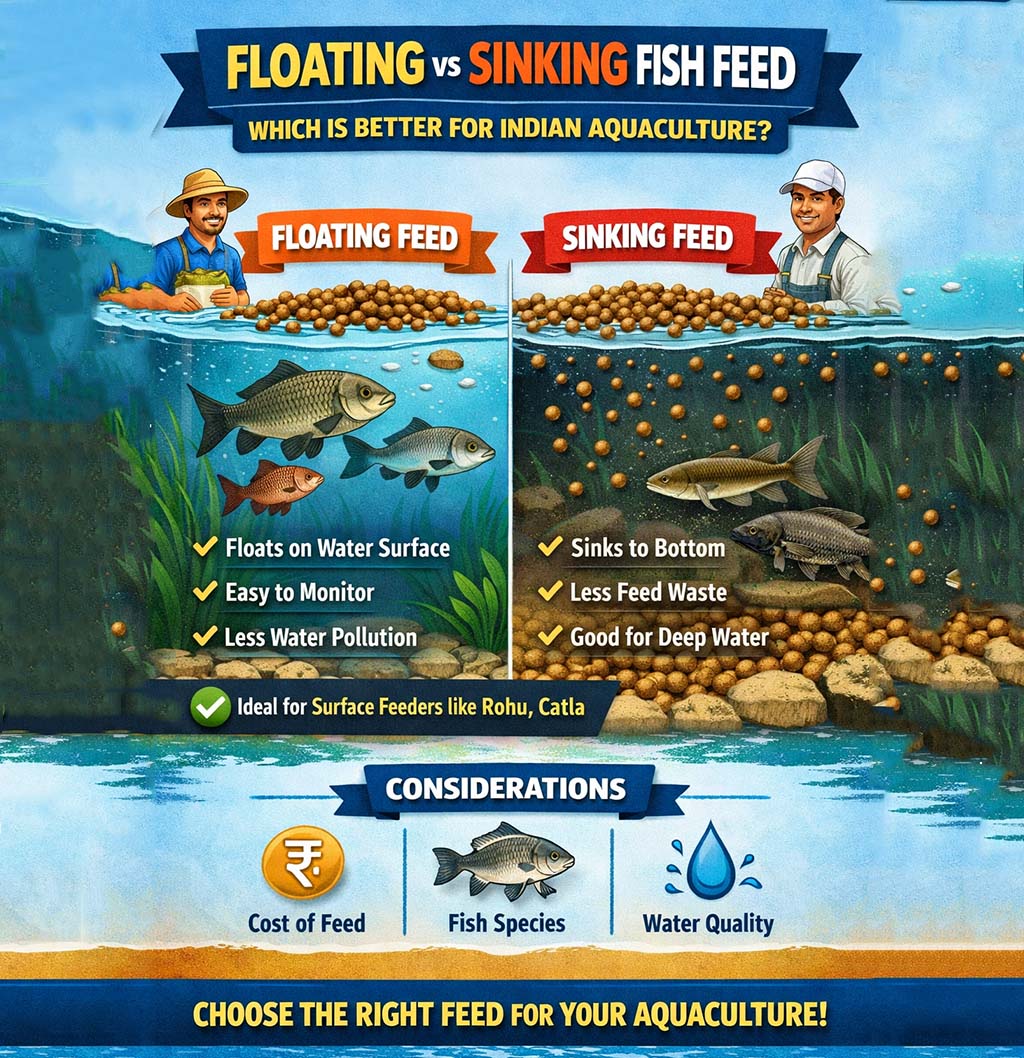
Floating Fish Feed is produced using up-to-date extrusion methods, whereby the pellets remain buoyant on the surface of the water for longer periods. Floating fish feed is one of the main feeds used by fish farmers practising both intensive and semi-intensive farming methods throughout India.
How Does Floating Fish Feed Work?
Floating Pellets will always be visible on the water’s surface, making it easier for both fish to eat naturally and for the farmer to observe when fish are ready to stop consuming feed.
Advantages of Floating Fish Feed
• Easier to monitor feed consumption
• Reduced feed wastage
• Better Feed Conversion Ratios (FCR)
• Improved Water Quality
• Reduced risk of over-feeding
• Easier to observe fish health
Happy Feeds produces high-quality Floating Fish Feed specifically formulated for many of India’s Indigenous Species such as Tilapia, Pangasius, Rohu, Catla and Mrigal.
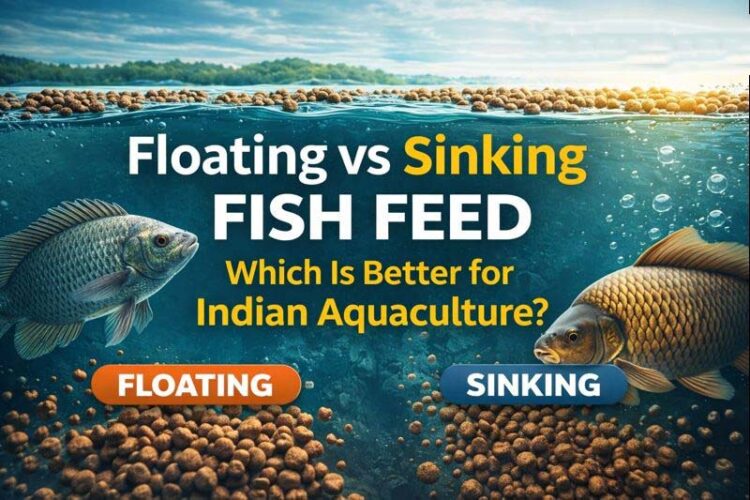
What Is Sinking Fish Feed?
Pellets sink quickly in ponds, where they are used primarily in both traditional and extensive production systems that do not involve feeding. Below are some of the limitations of sinking fish feeds in those environments:
- Difficult to measure feed consumption
- Feed wastage is more likely
- Unconsumed feed settles to the pond bottom
- Ammonia levels increase, and then water pollution,
- Over time, the amount of oxygen decreases
While using sinking feed initially seems like a low-cost option, there are many hidden costs associated with using low-quality water and slow-growing fish that will reduce overall profits.
Floating vs Sinking Fish Feed: Key Differences
| Feature | Floating Fish Feed | Sinking Fish Feed |
| Feed Visibility | Clearly visible | Not visible |
| Feed Control | Easy to manage | Difficult |
| Feed Wastage | Minimal | High |
| Water Quality | Maintained | Can degrade |
| FCR | Better | Lower |
| Farming Type | Commercial & intensive | Traditional |
Impact on Water Quality
Fish farming success is greatly impacted by water quality. Poor water quality can lead to stress in fish, higher disease prevalence and slower growth.
Impact Of Floating Fish Feed On Water Quality And Health
Because farmers can remove the floating fish feed that has not been consumed, it prevents decomposing until dissolved oxygen levels drop and ammonia builds up.
Impact Of Sinking Fish Feed On Pollution In Ponds
Big problems arise when fish feed sinks to the bottom of the pond because it decomposes, adding to the pond’s pollution and gaseous by-products; as a result, there is an increased probability of disease outbreaks.
It is wise for Indian aquaculture farmers facing rising input costs to improve water quality by using floating fish feed.
Which Fish Species Prefer Floating Feed?
Most fish species raised for sale in India are grown more effectively on floating fish feed. These species include: Tilapia, Pangasius, Rohu, Catla, and Mrigal. Happy Feeds produces floating fish food that is specially formulated to meet the needs of each fish at every stage of its growth cycle.
Feed Conversion Ratio: The Importance of FCR
Feed Conversion Ratio (FCR) indicates how well fish utilise feed to put on weight. The lower the FCR, the greater the economic profit for the fish farmer.
Floating Feeds Create Higher FCR
Floating fish feed improves FCR by promoting a uniform feeding pattern, promoting even digestion, and limiting feed waste.
Sinking Feeds and Their Drawbacks
Farmers cannot see how much feed has been consumed when using sinking feed. This leads to variable fish growth and higher feed costs to the fish farmer.
The higher the FCR, the higher the fish farmer’s sales price.
Cost Comparison: Floating vs Sinking Feed
The higher price of floating fish feed per kilogram compared with sinking fish feed is offset by fuel savings from shorter feeding times, reduced feed waste, lower disease treatment costs, higher growth rates, and a shorter time to market. Happy Feeds – Providing the best value product for our customers means more than just lower prices.
Why Floating Fish Feed Is Better for Indian Aquaculture
The aquaculture industry in India is increasingly adopting sustainable and commercialised practices. One aspect that supports these practices is the use of floating fish feed, which provides fish farmers with many benefits, including:
– Increased production
– Cleaner ponds
– Healthier fish
– Greater profit margins
Floating fish feed is a good investment for farmers looking to expand their business and meet consumer product demand.
What are the Benefits of Choosing Happy Feeds?
Happy Feeds is an experienced and trusted manufacturer of aquaculture fish feed in India. We manufacture:
– Floating fish feed is scientifically formulated
– Consistent high-quality pelleted feeds
– High digestibility feeds
– Better growth performance
– Farmer-oriented nutritional solutions
We design fish feed to provide optimal nutrition for fish, based on the Indian climate, pond conditions, and the needs of the fish farmer.
👉 Visit: https://www.happyfeeds.co.in/
Conclusion
Floating fish feed has become widely accepted as the optimal choice across India’s aquaculture industry. Floating fish feed not only provides higher feed efficiency but also maintains water quality, enhances fish growth, and, overall, provides a higher profit margin for the farmer.
Farmers who use premium-quality floating fish feed from Happy Feeds can adopt modern aquaculture practices and ensure a future that is both more sustainable and more profitable.
FAQ:
1. Can I use floating feed for all types of fish?
Yes! Nearly all commercially raised fish species in India will benefit from using floating fish feed.
2. Will floating fish feed result in less pollution to the pond?
Yes! Because unused floating feed can be removed before it decomposes.
3. Is floating fish feed a cost-effective feeding strategy?
Yes! Floating feed with a better FCR (Feed Conversion Ratio) and less feed waste will be less costly in the future.
4. Will small-scale producers benefit from the use of floating fish diets?
Absolutely. Floating feed benefits farms of all sizes.
5. Where can I buy quality floating fish feed in India?
You can explore reliable options at Happy Feeds: https://www.happyfeeds.co.in/
Thanks for reading
Click here to read this: How to Choose the Right Floating Fish Feed