
Table of Contents
- Introduction
- What is Smart Fish Farming?
- Why Technology is Transforming Aquaculture
- Smart Feeding Systems
- AI-Powered Fish Feeding Technology
- IoT-Based Water Quality Monitoring
- Automatic Aeration Systems
- Smart Sensors for Fish Farming
- Mobile Apps for Farm Management
- Data Analytics in Aquaculture
- Drone Technology in Fish Farming
- Benefits of Smart Fish Farming Technologies
- Challenges of Technology Adoption
- Future of Smart Aquaculture in India
- Conclusion
- FAQs
Smart Fish Farming Technologies Aquaculture is going through an evolution process where technology is becoming one of the biggest tools to increase fish production. The traditional ways of producing fish through farming techniques are being replaced gradually with more contemporary systems that incorporate automation, artificial intelligence (AI), sensors, and data analytics in order to improve efficiency.
By 2026, fish farmers who are producing fish successfully are no longer relying only on their experience. They are adopting Smart Fish Farming Technologies to monitor fish health, manage feeding schedules, manage water quality, eliminate feed wastage, increase growth performance and increase farm profitability.
Fish farmers interested in maximizing growth and minimizing costs need to understand these technologies.
What is Smart Fish Farming?
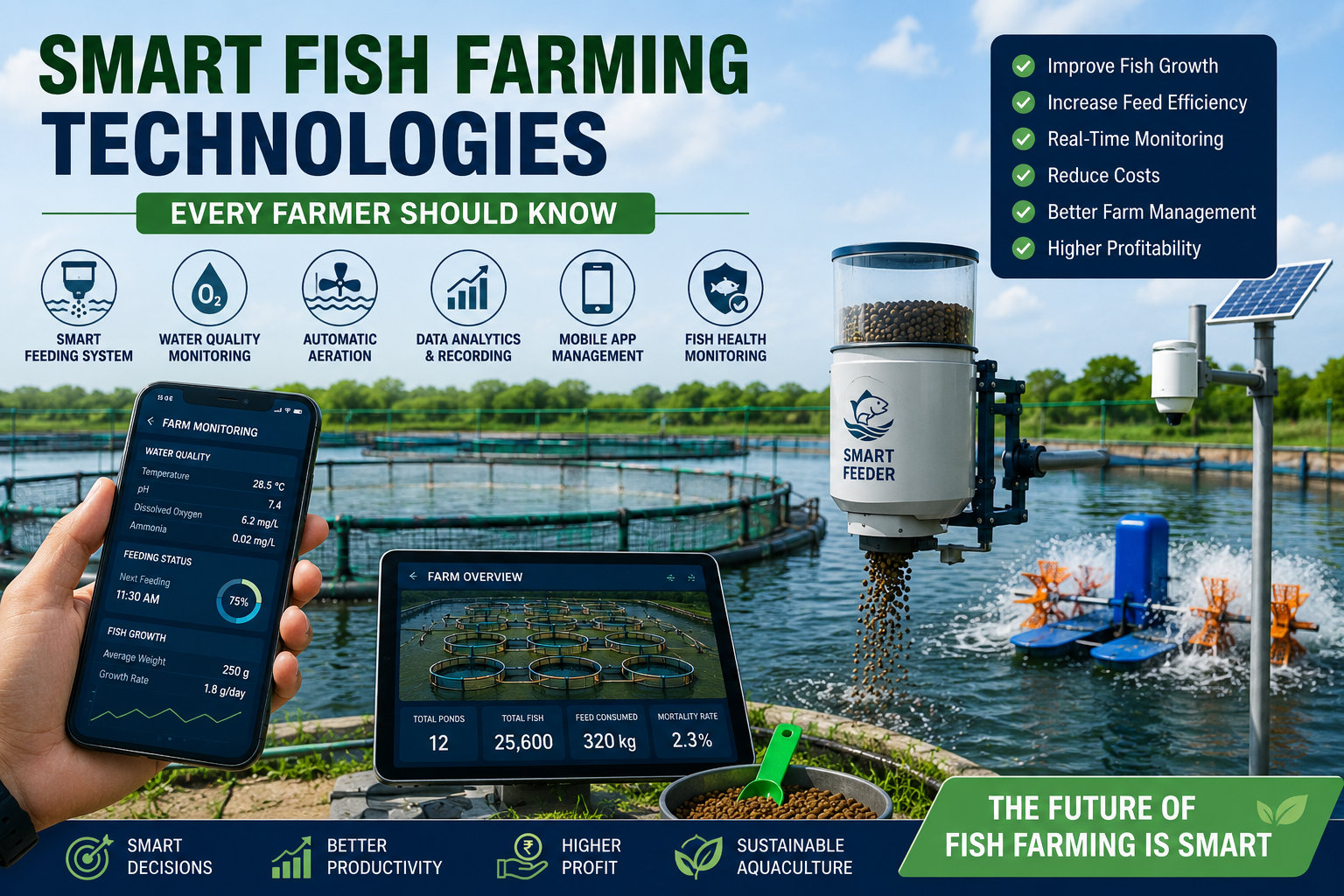
Smart Fish Farming is a term used to describe all the advanced technologies used to automate or improve aquaculture operations.
These technologies allow farmers to do the following:
- Monitor fish health
- Control feeding schedules
- Manage water quality
- Reduce feed waste
- Improve growth performance
- Increase overall farm productivity
By utilizing technology along with modern fish nutrition and management practices, farmers can realize improved results with fewer resources.
Why is Technology Transforming Aquaculture? The fish farming industry faces many issues:
- Rising costs of feed
- Water quality management
- Disease outbreaks
- Labor shortages
- Environmental impacts
Smart technologies assist in reducing the above-listed challenges with automation and real-time data monitoring.
The Benefits of using smart technologies include:
- Better decision-making
- Increased production efficiencies
- Lowering operating costs
- Improving fish health
AI-Powered Fish Feeding Technology
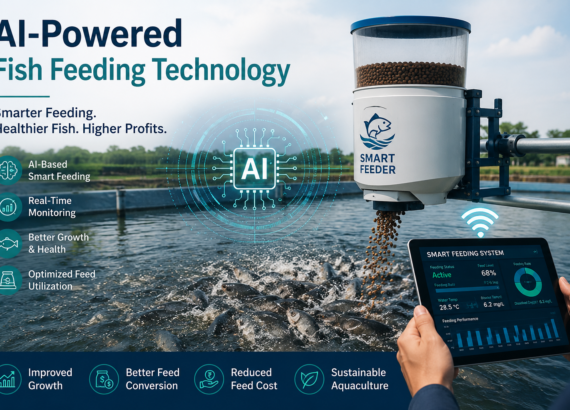
Artificial Intelligence (AI) is one of the most incredible innovations in aquaculture, and AI feeding systems can enable:
- Observation of fish behaviour
- Identification of their feeding habits
- The monitoring of their levels of appetite, and
- The frequency with which to feed fish
By doing so, this can help to eliminate the chance of human error in feeding fish and help ensure they receive the most appropriate nutrition.
Some of the benefits of AI-based feeding systems are as follows:
• Improvement of Feed Utilisation
AI will assist in eliminating over-feeding and under-feeding.
• Improved Fish Growth
Fish will receive nutrition based on their actual requirements.
• Reduction of Feed Costs
Feed wastage will be reduced to a minimum.
As the cost of AI technology decreases, it is expected that the number of Indian fish farmers utilising these systems will increase.
IoT-Based Water Quality Monitoring
Water quality is extremely important for the health of fish.
The Internet of Things (IoT) will allow farmers to monitor water quality in real time.
IoT sensors can monitor:
- Dissolved oxygen
- Temperature
- PH levels
- Ammonia levels
- Water turbidity
This data will be sent directly to the farm so the farmer can quickly respond to any changes in water quality and thus minimising the chance of:
- Fish stress
- Disease
- Mortality
Automatic Aeration Systems
Oxygen is necessary for fish to survive and thrive.
Traditional aeration processes require constant monitoring.
Automatic aeration systems continuously monitor the oxygen level, activate automatically when the amount of oxygen decreases, and increase the comfort and health of the fish.
Some benefits of using automatic aeration systems include:
- Increased fish survival rates
- Faster fish growth
- Less labour
These systems are continuing to grow.
Data Analytics in Aquaculture
Data is becoming one of the most valuable resources in fish farming.
Modern analytics platforms can evaluate:
- Growth rates
- Feed efficiency
- Mortality trends
- Water quality performance
Farmers can identify problems early and optimize production strategies.
Benefits include:
Improved Profitability
Better decisions lead to higher returns.
Reduced Risk
Potential issues are detected sooner.
Enhanced Productivity
Farm operations become more efficient.
Drone Technology in Fish Farming
The increasing value of data in aquaculture.
The use of modern analytics tools enables the assessment of things such as:
- Growth
- Feed efficiency
- Mortality patterns
- Water quality performance
These data points enable farmers to detect issues early and improve production capabilities.
The advantages are:
Increased profitability
More informed decisions equate to increased profitability.
Lower risk
Potential issues can be identified sooner.
Increased productivity
Farm operations become more efficient.
Drones and aquaculture.
The use of drones in aquaculture is increasing.
Examples are:
- Pond assessment
- Water surface assessment
- Farm mapping
- Infrastructure evaluation
For large-scale farms, drones reduce the time and number of workers required to monitor multiple ponds.
Additionally, drones improve security and operational effectiveness.
Smart aquaculture technologies and their benefits.
Smart technologies produce several benefits.
- Increased feed efficiency
- Automated systems reduce feed waste and increase feed conversion.
- Increased fish health
- Continuous monitoring maintains optimum conditions.
- Reduced labor costs
- Automation decreases manual labor demands.
- Increases in production
- Fish raised in optimal conditions grow faster than fish raised in sub-optimal conditions.
- Better resource utilization
- Ingredients used in aquaculture are utilized more efficiently than ingredients used in traditional aquaculture.
The increased profitability from these four benefits is substantial.
Challenges of adopting new technologies in aquaculture.
There are numerous challenges to adopting smart technologies in aquaculture.
Initial investment
Technologies require an upfront financial investment.
Technical knowledge
Farmers need to be educated on how to use advanced technologies.
Internet Connectivity
Some rural areas still face connectivity limitations.
Maintenance Requirements
Equipment must be maintained properly.
However, the long-term benefits often outweigh these challenges.
Future of Smart Aquaculture in India
Aquaculture in India is expected to take a huge leap forward in its use of technology over the next ten years or so.
The trends emerging are as follows:
AI-Driven Detection of Disease
Detecting health problems before they have a chance to spread.
Precision Feeding Systems
Meticulously providing specific species with their own unique nutrition automatically.
Cloud-Based Farm Management
Accessing farm data/records from any location, from any device (computers and smart devices).
Integrated Smart Farms
Using one interface that combines intuitive feeding, monitoring and analytics.
These advancements will increase productivity and sustainability.
The Role of Proper Fish Feed in Smart Farming
While technology is important, nutrition is still the most important factor in aquaculture.
Smart farming works best when you have:
- Top quality fish feed
- Premium floating fish feed
- Species specific formulations of feed
- Scientific feeding techniques
Quality fish feed is what makes an aquaculture enterprise successful.
Final Thoughts
Smart farming technologies for fish farming are changing the face of aquaculture by allowing farmers to become more efficient, save money and grow better fish. Technologies being used today include AI enabled feeding systems, IoT water monitoring, automated aeration, smart phone apps for farm management and data analytics all will help shape the future of fish farming.
As the aquaculture sector in India continues to grow, aquaculture farmers who use smart technologies, combined with high-quality feed, will position themselves to succeed for a long time to come. Investing in technology and innovation today will lead to healthier fish farming, increased productivity and further advancement in aquaculture.
FAQs
- What are Smart Fish Farming Technologies?
Smart Fish Farming Technologies include AI, IoT sensors, automated feeding systems, data analytics, and mobile applications used to improve aquaculture management.
- How do smart feeding systems help fish farmers?
They provide precise feeding, reduce feed wastage, improve FCR, and support faster fish growth.
- What is the role of AI in fish farming?
AI helps monitor fish behavior, optimize feeding schedules, detect health issues, and improve production efficiency.
- Why is water quality monitoring important?
Water quality directly affects fish health, growth, survival rates, and overall farm productivity.
- Are smart fish farming technologies suitable for small farms?
Yes. Many technologies are now affordable and scalable for small and medium-sized fish farms.
Thanks for reading
……………………………………………………………………………………………………………………………………………….
Click here to read this: How to Choose the Right Floating Fish Feed
Visit our product page to see all products: Click here to visit
Need help choosing feed? Use our Free Feed Calculator
Visit: Dust Fish Feed Products