
Protein is one of the most important nutrients in fish nutrition because it supports growth, muscle development, tissue repair, immune function, and overall health. However, the ideal protein level is not the same for every fish species. Different fish have different nutritional requirements depending on their age, size, feeding habits, metabolism, water temperature, and farming conditions. Providing the right amount of protein through a balanced fish feed can improve growth performance, feed utilisation, survival, and farm profitability. On the other hand, using either too little or unnecessarily high protein can affect fish health and increase production costs. For this reason, fish farmers should understand the protein requirements of the species they are raising and select feed accordingly.
Why Protein Is Important in Fish Feed
Protein provides amino acids that fish require to build and maintain muscles, organs, enzymes, hormones, and other essential body tissues. Young and rapidly growing fish generally require more protein than larger fish because they are continuously developing new tissues. Protein also plays an important role in maintaining immunity and helping fish recover from stress, disease, handling, and environmental changes. When fish receive an appropriate amount of high-quality protein, they can convert feed nutrients into body mass more efficiently, resulting in better growth and feed conversion.
The protein requirement of fish is influenced by several factors. Species is one of the most important because carnivorous, omnivorous, and herbivorous fish have different nutritional needs. Life stage is another major factor. Fry and fingerlings generally need protein-rich diets, while grow-out fish can often perform well on moderately lower protein levels. Water temperature also affects metabolism and feeding activity, while stocking density, water quality, feed energy, and farming systems can influence nutritional requirements.
Protein quality is just as important as the percentage shown on a feed label. A feed containing a high crude protein percentage does not automatically provide better nutrition. Fish need a suitable balance of essential amino acids, and protein sources should be digestible and appropriate for the species. When protein is poorly utilised, more nitrogen can be released into the water, potentially contributing to water-quality problems. Therefore, a well-formulated feed should balance protein with energy, fats, carbohydrates, vitamins, and minerals.
Recommended Protein Levels for Different Fish Species
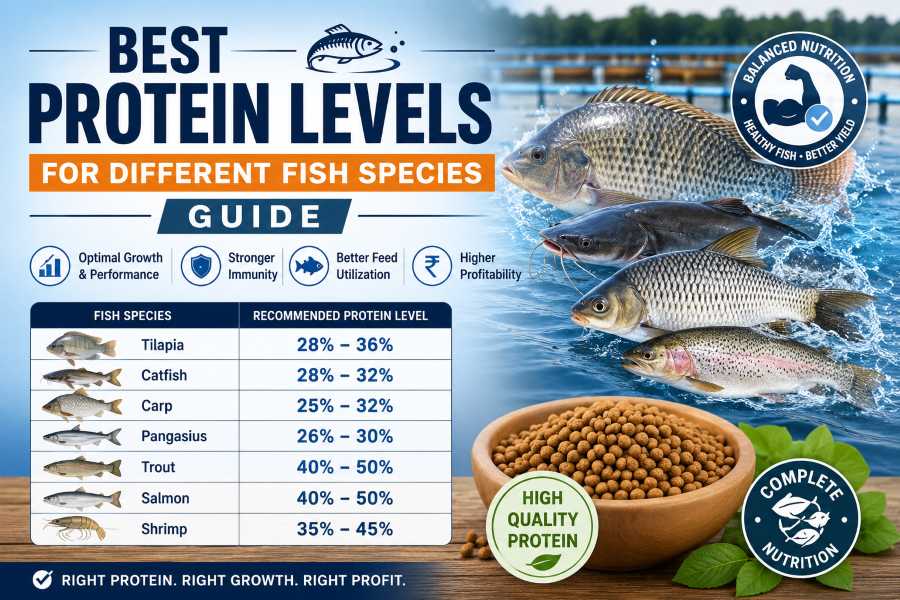
Protein requirements vary considerably among common aquaculture species. For tilapia, commercial feeds often contain approximately 28–36% crude protein during grow-out, while younger tilapia may require higher levels depending on their developmental stage and production system. Tilapia are omnivorous fish and can utilise plant-based ingredients effectively when the diet is properly formulated. Providing balanced protein rather than simply increasing protein levels can support good growth while keeping feed costs under control.
Catfish, including commonly farmed channel catfish, generally perform well on feeds containing approximately 28–32% protein during many grow-out stages. Smaller catfish may require higher protein levels than larger fish. Because catfish are capable of using energy from carbohydrates and fats, the overall balance between protein and dietary energy is important. A properly formulated catfish feed can support efficient growth without forcing protein to be used primarily as an energy source.
Carp, including common carp and related species, generally require moderate protein levels. Grow-out feeds may commonly contain around 25–32% protein, while younger fish can need higher levels. Carp are omnivorous and can utilise a variety of feed ingredients. Their protein requirement depends on species, size, farming environment, and feed formulation. Maintaining an appropriate balance of protein, energy, minerals, and other nutrients is important for consistent growth.
Rohu and other Indian major carps can generally perform well with diets containing moderate protein levels, with requirements changing according to life stage and culture conditions. Fry and fingerlings typically need more protein than adult or market-size fish. In practical aquaculture, feeds for young carp may contain roughly 30–40% protein, while grow-out diets may use lower levels depending on the formulation and production system. Farmers should select feed according to the specific growth stage rather than using one feed throughout the entire production cycle.
Pangasius, commonly farmed in intensive systems, generally uses grow-out feeds with protein levels around 26–30%, although the appropriate level depends on fish size, feed ingredients, environmental conditions, and farming practices. Young pangasius require comparatively higher protein concentrations. Since pangasius farming can involve high stocking densities, feed quality and digestibility are particularly important for maintaining growth and water quality.
Trout and other cold-water carnivorous fish generally require higher-quality protein than many omnivorous species. Trout feeds may commonly contain approximately 40–50% protein, particularly for younger fish, although requirements vary with fish size and production conditions. Trout also require highly digestible diets with appropriate amino acid profiles. Because carnivorous fish have different nutritional physiology from omnivorous species, their feed formulations need to be designed accordingly.
Salmon are also typically provided with relatively high-protein feeds, often around 40–50% depending on life stage, production system, and feed formulation. Protein is important for muscle development and growth, but salmon feeds also rely heavily on carefully balanced lipids as an energy source. The exact formulation is influenced by whether fish are in freshwater or marine production and by their stage of development.
Shrimp are not fish, but they are an important aquaculture species and are sometimes discussed alongside fish feed. Commercial shrimp feeds may contain roughly 35–45% protein depending on species, size, farming conditions, and formulation. Shrimp require appropriate amino acids and digestible nutrients, and feed quality can strongly influence growth and water quality.
These figures should be treated as general ranges rather than universal rules. The ideal protein level can change according to fish size, temperature, stocking density, feed ingredients, feeding frequency, water quality, and production objectives. Farmers should therefore use professionally formulated feeds designed for the target species and growth stage rather than selecting feed based solely on crude protein percentage.
How to Choose the Right Protein Level for Fish Farming
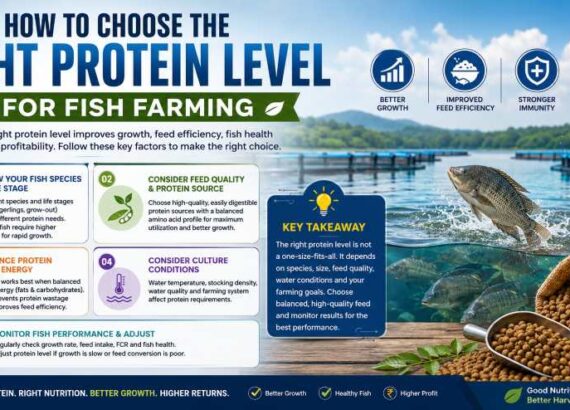
Selecting the correct protein level starts with identifying the fish species and growth stage. Fry, larvae, and fingerlings generally have higher protein requirements because they are growing rapidly. As fish become larger, their protein requirement as a percentage of feed often decreases, although their total daily nutrient intake continues to increase. Using different feeds during nursery, juvenile, and grow-out stages can therefore be more effective than feeding the same formulation throughout the production cycle.
Farmers should also consider feed digestibility. Highly digestible protein can be utilised more efficiently by fish, potentially reducing nutrient waste. The amino acid profile matters because fish cannot simply use all types of protein equally. A balanced feed should provide essential amino acids in proportions suitable for the species. Ingredients such as fishmeal, soybean meal, other plant proteins, and animal or microbial protein sources can be combined to create nutritionally balanced formulations.
Energy-to-protein balance is another important consideration. If a feed does not provide enough non-protein energy from suitable fats or carbohydrates, fish may use protein for energy rather than growth. Conversely, excessively high protein without appropriate energy balance can increase feed costs without producing proportional growth benefits. Good fish feed formulation therefore focuses on nutrient balance rather than maximising one nutrient.
Water quality should also be considered when selecting feed. Poorly digested or excessive nutrients can increase waste production and affect ammonia and other water-quality parameters. Efficient feeding practices, appropriate feeding rates, good-quality ingredients, and regular monitoring can help reduce waste. Farmers should observe fish behaviour, growth rate, feed consumption, and water conditions to determine whether their feeding program is working effectively.
Ultimately, the best protein level is the one that meets the nutritional needs of the particular fish at its current growth stage while providing good digestibility, amino acid balance, energy, and cost efficiency. Working with a qualified aquaculture nutritionist or selecting professionally formulated commercial feed can help farmers make more accurate decisions.
Frequently Asked Questions
- What percentage of protein is best for fish feed?
There is no single protein percentage that is best for all fish. Many omnivorous grow-out fish perform well on approximately 25–35% protein, while carnivorous species such as trout and salmon may require around 40–50%, depending on life stage and production conditions.
- Do baby fish require more protein?
Yes. Fry and fingerlings generally require higher protein levels than larger fish because they experience rapid growth and tissue development. Nursery feeds are therefore usually formulated with higher protein concentrations.
- Is higher protein always better for fish growth?
No. Excessively high protein does not necessarily produce faster growth. Protein must be balanced with energy, amino acids, fats, vitamins, minerals, and other nutrients. Overfeeding expensive high-protein feed can also increase production costs and nutrient waste.
- What protein level is suitable for tilapia?
Tilapia grow-out feeds commonly contain approximately 28–36% protein, while younger tilapia may require higher levels. The appropriate amount depends on fish size, water temperature, feed formulation, and farming conditions.
- How can farmers choose the right fish feed?
Farmers should choose feed according to species, fish size, growth stage, farming system, and production goals. They should consider protein quality, digestibility, amino acid balance, energy content, feeding rate, and manufacturer quality rather than looking only at the crude protein percentage.
Conclusion
Choosing the right protein level is essential for successful fish farming. Tilapia, carp, catfish, pangasius, trout, salmon, and other species have different nutritional requirements, and their needs also change as they grow. A balanced diet with appropriate protein, amino acids, energy, fats, vitamins, and minerals can support healthy growth and efficient feed utilisation. Instead of assuming that the highest protein feed is always the best option, farmers should select species-specific and age-appropriate feed. Proper nutrition combined with good water quality and responsible feeding practices can improve productivity, fish health, and overall aquaculture profitability.
Thanks for reading
……………………………………………………………………………………………………………………………………………….
Click here to read this: How to Choose the Right Floating Fish Feed
Visit our product page to see all products: Click here to visit
Need help choosing feed? Use our Free Feed Calculator
Visit: Dust Fish Feed Products