
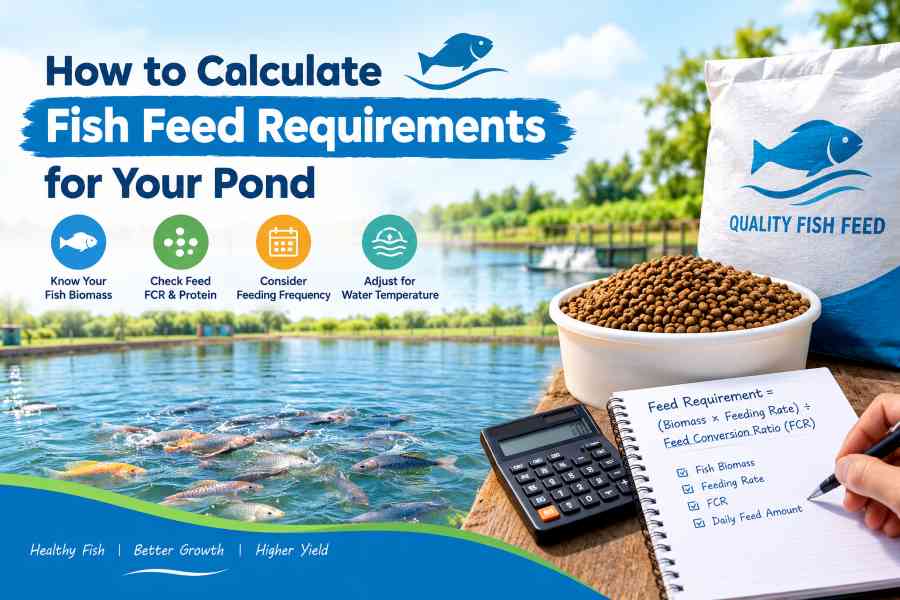
Calculating the amount of feed is one of the most important parts of successful pond fish farming. Giving little feed can slow down fish growth. Giving much feed can waste money and make the water dirty. The correct feed amount depends on things. These include how many fish are in the pond their weight, the type of fish their growth stage, water condition, natural food in the pond and the quality of the feed.
FAO guidance says feeding should be based on the weight of fish in the pond. This is called biomass. It’s better than using the number of fish you first stocked.
The first step is to estimate biomass. Biomass is the live weight of all fish. A simple way to calculate it is: Fish Biomass = Number of Fish × Average Weight of One Fish. For example if there are 5,000 fish and each weighs 100 grams the biomass is 500 kg. Once you know the biomass you can use a feeding percentage to find feed amount.
If the feeding rate is 2% of the biomass per day a pond with 500 kg of fish needs 10 kg of feed per day. That’s 500 kg × 2% = 10 kg… This percentage isn’t the same for every fish or stage. Feeding rates change as fish grow. FAO says feeding rates should be adjusted as fish get bigger. They shouldn’t stay the same all the time.
It’s important to check fish weight. Fish get heavier over time. Farmers should take samples from parts of the pond. Fish near feeding areas might not be typical of the group. Keeping records of fish weight, feed given growth and survival helps make future feed calculations more accurate.
How to Calculate the Daily Fish Feed Quantity
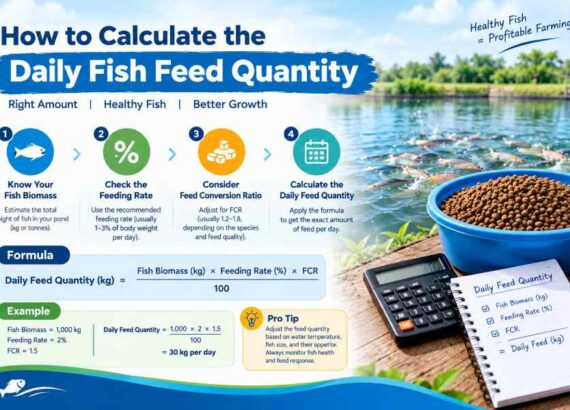
After you know the biomass the next step is to find the feeding rate. The basic formula is:
Daily Fish Feed = Total Fish Biomass × Feeding Rate (%)
For example if biomass is 800 kg and the feeding rate is 2% the daily feed is:
800 kg × 2 ÷ 100 = 16 kg of feed per day.
This gives a starting point… Real feeding should be checked based on how hungry the fish are, how fast they grow, water conditions and how much feed they eat. FAO says feeding rates usually go down as fish grow larger. Their feed needs as a percent of body weight change over time.
Feeding rates also depend on fish type and growth stage. Young fish need nutrition than big growing fish. In pond carp culture feeding rates are often around 1–2% for growing fish… Other systems or stages might need different rates. So farmers should follow feeding advice for their fish, size, feed and farming setup. Don’t use one rule for every pond.
Another key idea is Feed Conversion Ratio or FCR. FCR shows how much feed is needed to gain one unit of fish weight. The formula is:
FCR = Total Feed Used ÷ Fish Weight Gain
For example if 1,500 kg of feed leads to 1,000 kg of fish gain the FCR is 1.5. A lower FCR means less feed is needed for the growth… Fcr must be understood with the species, feed, system and how it’s measured.
FCR helps check feeding efficiency and control feed costs. If feed is going up but fish aren’t growing much the farmer should look for problems. These could be feed size, poor feed quality, overfeeding, disease, bad water or wrong biomass estimate.
The time and way feed is given matter. Some systems split the feed into morning and afternoon. This helps farmers watch feeding behavior and avoid giving much at once.
For farming using quality formulated feed makes things easier. The feed is made to give nutrition. Pellet size should match the fish size. Follow the feed manufacturer’s guide. Adjust based on what you see in the pond and how fish are doing.
Adjusting Fish Feed According to Growth Water Conditions and Consumption
Feed calculation should not be done once. Forgotten. As fish grow, their average. Total biomass change. So daily feed needs must be. Updated. Regular sampling, record keeping and observation help with this. FAO says it’s important to check fish size and biomass often. Good feeding depends on knowing the weight and number of fish.
For example a pond starts with 600 kg biomass and a 2% feeding rate. Daily feed is 12 kg. After a weeks sampling shows biomass is now 750 kg. At the 2% rate daily feed becomes 15 kg. This shows why feed must be updated as fish grow.
Farmers should also watch how much feed is eaten. If lots of feed is left over giving the amount every day is a waste. It can also pollute the water. FAO warns that overfeeding wastes feed and harms water quality. Underfeeding can hurt production.
Water temperature, oxygen levels, fish health and other conditions affect feeding. If fish are stressed or water is bad they may eat less. Just adding feed won’t help. First find the problem and fix it.
Natural food in the pond also matters. Fish may eat bugs, algae or other things in the water. So they may need supplemental feed. That’s why feeding plans should consider the pond, not just a formula.
Good feed management mixes math with watching. Keep a record: stocking numbers, survival, average weight, biomass, daily feed, feed type, growth and FCR. These records help see if feeding is working well.
Using a quality floating fish feed helps too. Floating pellets stay on the surface. You can see what’s eaten and what’s left. This makes it easier to judge how much to feed… Always match feed type and amount to the fish species and their growth stage.
Conclusion
Accurately calculating fish feed helps farmers save money grow fish and manage ponds better. Start by estimating fish number and average weight. Then calculate biomass. Multiply that by the feeding rate. The formula Daily Feed = Fish Biomass × Feeding Rate (%) is a start… Adjust the feeding based on fish growth, appetite, water and performance.
For results combine biomass calculation, regular sampling, good feed, FCR tracking and record keeping. Choose quality feed. Use it as needed. This leads to feeding and sustainable pond farming.
Happy Feeds provides fish feed solutions for aquaculture nutrition and fish growth. Visit Happy Feeds to learn more about fish feed products and aquaculture solutions.
FAQs
How do I calculate fish feed requirements for a pond?
Calculate the fish biomass and multiply it by the feeding rate. The basic formula is Daily Feed = Total Fish Biomass × Feeding Rate (%).
What is fish biomass in pond farming?
Fish biomass is the weight of all fish in the pond. It’s estimated by multiplying number of fish by weight per fish.
How often should fish biomass be checked?
Check often. Fish. Survival changes. Regular sampling helps update biomass and feeding amounts.
What is FCR, in fish farming?
FCR is Feed Conversion Ratio. It’s total feed used divided by fish weight gained.
Can overfeeding affect pond water quality?
Yes. Uneaten feed can pollute the water. Feed should match biomass, feeding rate and actual fish consumption.
Thanks for reading
……………………………………………………………………………………………………………………………………………….
Click here to read this: How to Choose the Right Floating Fish Feed
Visit our product page to see all products: Click here to visit
Need help choosing feed? Use our Free Feed Calculator
Visit: Dust Fish Feed Products