
A properly managed pond is one of the foundations of successful fish farming. Pond water is not simply a place where fish live—it is an ecosystem containing fish, plankton, microorganisms, organic matter, nutrients and other biological components. When this ecosystem becomes unbalanced, fish growth, feed efficiency, water quality and overall farm productivity can suffer.
This pond-cleaning guide outlines steps farmers can follow to maintain healthier ponds and prepare them for productive fish culture. Regular pond maintenance helps control weeds, accumulated sludge, unwanted organisms, waste material and other factors that can negatively affect the culture environment.
According to ICAR guidance, pond preparation can include desilting and the application of agricultural lime, while maintaining drainage and screened inlet and outlet structures is important for reducing contamination and preventing unwanted fish from entering the pond.
When Should You Clean a Fish Pond?
Pond cleaning is particularly important before stocking fingerlings after harvesting or whenever excessive sludge, weeds, dead organic matter or poor water quality becomes a concern.
Farmers should regularly inspect:
Pond water colour and clarity
Excessive aquatic weeds
Sludge accumulation
Dead fish or organic waste
Pond embankments
Inlet and outlet screens
Water pH and other quality parameters
Signs of unusual fish behaviour
Observation is an important part of aquaculture water management because changes in water quality or quantity can require timely corrective action.
Step‑by‑Step Pond Cleaning and Preparation Process
Effective pond cleaning is more than removing visible dirt from the water. It involves managing the pond bottom, water, weed matter, infrastructure and overall aquatic environment.
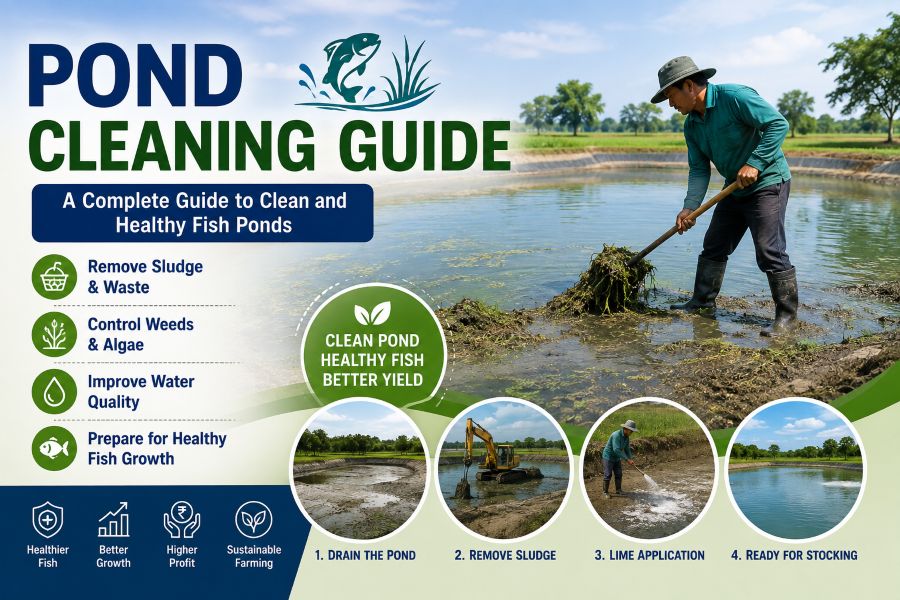
Step 1: Drain the Pond When Appropriate
For ponds being prepared between culture cycles, draining can make cleaning and bottom management easier. Where complete drainage is practical, remove fish and other aquatic organisms before carrying out cleaning work.
Drainage should be managed carefully so that cultured fish do not escape and surrounding water sources are not contaminated. FAO guidance recommends using screens during filling and draining operations.
Step 2: Remove Excess Sludge
Sludge consists of accumulated matter, uneaten feed, dead organisms, soil particles and other materials that settle at the pond bottom.
Excessive sludge can interfere with pond productivity. Contribute to deterioration of the culture environment. Remove accumulated sludge where necessary and dispose of it responsibly rather than allowing it to flow directly into nearby water bodies.
In aquaculture, managing organic waste is especially important because increasing fish biomass can increase the quantity of decomposing organic material in the pond.
Step 3: Remove Weeds and Unwanted Material
Excessive floating, submerged and marginal weeds should be controlled. Much vegetation can occupy pond space and interfere with the availability of nutrients and natural food for cultured fish.
Remove:
Floating weeds
Submerged weeds
Algae when problematic
Fallen leaves
Plastic and other waste
Dead fish
Other unwanted organic material
ICAR fish‑farming guidance also recommends removing floating and submerged weeds as part of regular pond maintenance.
Step 4: Dry the Pond Bottom
When the production cycle and local conditions allow, drying the pond bottom can be a part of pond preparation. Drying helps expose the pond bottom and makes accumulated organic material easier to identify and manage.
However, drying time should depend on soil type, weather conditions, pond structure, water availability and the culture system. Avoid following a one‑size‑fits‑all drying schedule.
Step 5: Apply Lime Based on Pond Conditions
Liming is commonly used in fish pond preparation and water‑quality management. It can help with soil‑water conditions, but the appropriate quantity should be determined according to factors such as soil characteristics, pH, alkalinity and the specific aquaculture system.
ICAR’s recent farmer advisory recommends lime during pond preparation with the objective of maintaining pond water pH in the 7.0–8.5 range.
Important: Do not apply lime simply because you want faster pond cleaning. Application rates should be based on pond conditions and professional/local fisheries recommendations.
Step 6: Inspect and Repair Pond Infrastructure
Cleaning is also an opportunity to inspect the entire pond structure.
Check:
Embankments and pond bunds
Water inlet
Water outlet
Screens
Pipes
Leakage points
Erosion
Drainage arrangements
Repair cracks, leakages, damaged bunds and blocked screens before restarting the culture cycle. Regular maintenance can prevent structural problems from becoming expensive problems later.
Maintaining Pond Water Quality After Cleaning
Cleaning the pond is the beginning. Continuous pond management is necessary to maintain an environment for fish growth.
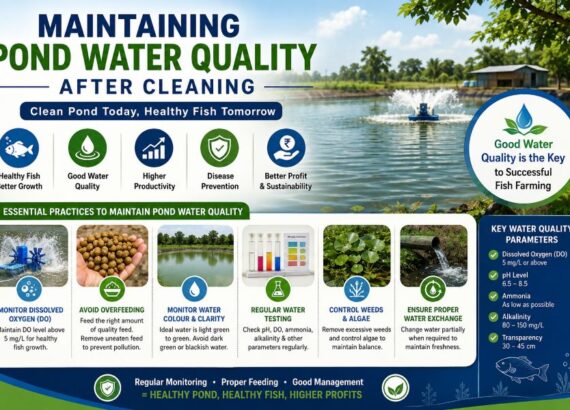
Water quality is influenced by parameters including temperature, transparency, turbidity, water colour, pH, alkalinity, hardness, ammonia, nitrite, nitrate, plankton and dissolved oxygen.
Monitor Dissolved Oxygen
Dissolved oxygen (DO) is particularly important for fish health and growth. FAO guidance identifies 5 mg/L to saturation as an optimum range for good fish growth, while prolonged very low oxygen levels can become dangerous.
Farmers should pay attention to fish behaviour during early morning hours, when oxygen can be low in some pond systems.
If oxygen becomes insufficient, aeration or water‑management measures may be required. Mechanical aerators can help increase oxygen transfer into pond water.
Avoid Overfeeding
After cleaning, maintaining feeding practices is essential. Excess feed that remains uneaten can become waste and negatively influence water quality.
Use a quality fish feed. Adjust feeding according to fish biomass, species, water temperature, feeding response and farm‑management recommendations. Good feed management can reduce waste while supporting fish growth.
Monitor Water Colour and Fish Behaviour
Water colour can provide early clues about changes in pond conditions. Sudden changes, dark or blackish water, excessive algal growth, fish gasping at the surface, reduced feeding or unusual swimming behaviour should not be ignored.
ICAR specifically advises farmers to monitor water colour because deep green or blackish water can indicate potentially harmful algal blooms.
Keep the Pond Environment Clean
A successful pond cleaning routine should continue throughout the production cycle. Farmers should regularly remove floating material, inspect screens, control excessive weeds and monitor water quality.
Scientific pond management increasingly combines pond preparation, quality seed, fish feed, water‑quality monitoring and fish health management rather than treating each activity separately. ICAR training programmes for fish farmers similarly emphasise pond preparation, feeding, water‑quality management and fish health monitoring as components of scientific fish culture.
For fish farmers looking to improve productivity, choosing a quality feed is also an important part of the overall pond‑management strategy. A clean pond provides the foundation while feeding and monitoring help maintain the culture environment throughout the farming cycle.
Frequently Asked Questions About Pond Cleaning
- How often should a fish pond be cleaned?
There is no cleaning frequency suitable for every pond. Major cleaning and bottom preparation are commonly performed between production cycles or before stocking, while weeds, waste, screens and pond structures should be checked regularly during culture.
- Why is removing pond sludge important
Excess sludge contains accumulated organic material and can contribute to poor pond conditions. Removing sludge during pond preparation can help create a more manageable environment for the next production cycle.
- Is lime necessary for every fish pond?
Not. Lime application should depend on pond soil and water conditions, including pH and alkalinity. Farmers should follow technical recommendations rather than applying an arbitrary quantity.
- What are the signs that a fish pond needs attention?
Warning signs include water colour, excessive weeds or algae, bad odour, excessive organic waste, fish gasping at the surface, reduced feeding activity and sudden changes in fish behaviour. Water‑quality testing can help identify the problem.
- How can pond cleaning improve fish farming?
Proper pond preparation can help manage sludge, weeds, waste and unwanted organisms while creating conditions for water‑quality management. However, cleaning alone does not guarantee production; stocking, feeding, oxygen management, water quality and fish health must also be managed properly.
Conclusion
A well‑maintained pond is the foundation of sustainable fish farming. Following a pond cleaning guide—including appropriate draining, sludge removal, weed control, pond‑bottom preparation, liming when required, infrastructure inspection and water‑quality monitoring—can help farmers create a healthier environment for cultured fish.
The effective approach is not to clean the pond once and forget about it. Instead, farmers should combine observation, responsible feeding, water‑quality testing, weed management, oxygen monitoring and proper pond maintenance throughout the culture cycle. With scientific pond management and suitable fish feed, farmers can work toward better resource utilisation for fish and improved aquaculture productivity.-
Thanks for reading
……………………………………………………………………………………………………………………………………………….
Click here to read this: How to Choose the Right Floating Fish Feed
Visit our product page to see all products: Click here to visit
Need help choosing feed? Use our Free Feed Calculator
Visit: Dust Fish Feed Products