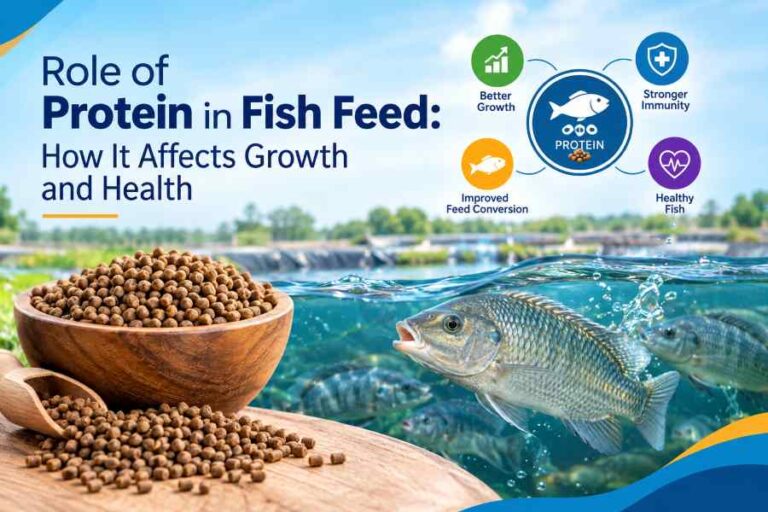

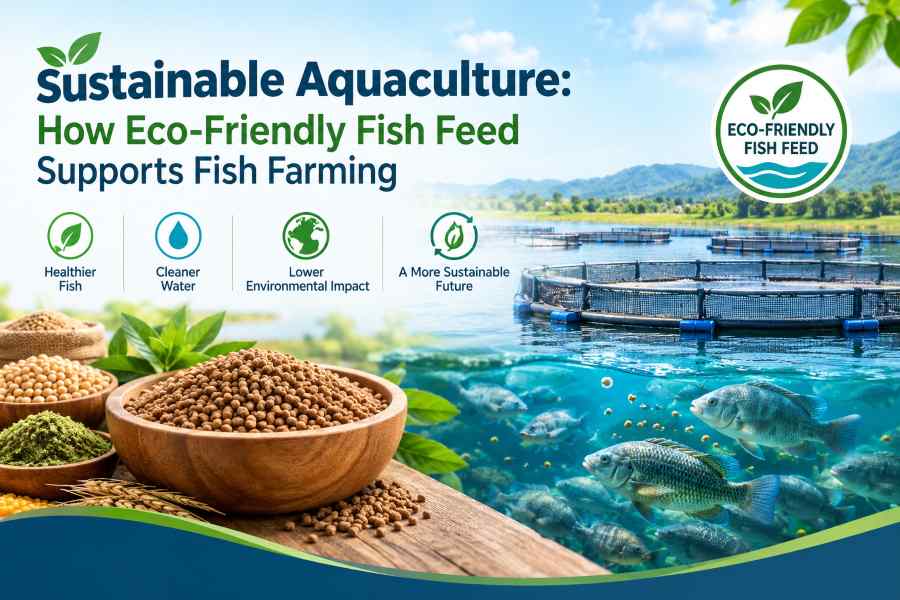
Aquaculture has become an important part of the global food industry providing a reliable source of protein while creating employment and business opportunities for fish farmers. In India the growing demand for freshwater fish, including Rohu, Catla, Mrigal, Tilapia and Pangasius has increased the need for responsible fish farming practices. However as aquaculture expands farmers must address challenges such as rising feed costs, water pollution, resource consumption and maintaining fish populations. Sustainable aquaculture offers an approach to balancing fish production with environmental protection and eco-friendly fish feed plays a vital role in achieving this balance.
Sustainable fish farming focuses on using resources maintaining water quality improving fish health and reducing unnecessary waste. One of the important steps toward achieving these goals is selecting the right fish feed. Quality, nutritionally balanced fish feed helps fish grow efficiently while reducing the amount of uneaten food and waste entering the pond environment. For fish farmers looking to improve productivity and long-term profitability choosing aqua feed is an important investment. Happy Feeds supports the development of aquaculture by highlighting the importance of quality fish nutrition and responsible feeding practices for a more sustainable future.
Understanding Sustainable Aquaculture and the Importance of Eco-Friendly Fish Feed
Aquaculture refers to fish farming practices that support consistent production while protecting natural resources and maintaining the health of aquatic ecosystems. Of focusing only on increasing fish production, sustainable fish farming considers the long-term effects of farming activities on water quality, fish health, feed resources and operating costs. This approach encourages farmers to make decisions about stocking density feeding schedules, pond management and the selection of suitable fish feed. By adopting farming methods aquaculture businesses can improve efficiency while reducing avoidable environmental impacts.
Fish feed is one of the important factors influencing the sustainability of an aquaculture operation. Fish require a combination of protein, fats, carbohydrates, vitamins and minerals to support growth, metabolism, immunity and overall development. When fish receive feed that meets their requirements they can utilize nutrients more effectively. In contrast unsuitable or poorly managed feed can result in growth increased feed wastage and the accumulation of organic matter in ponds. Therefore selecting quality fish feed is essential for improving both farm productivity and environmental performance.
Eco-friendly fish feed generally focuses on nutrient utilization, responsible ingredient sourcing and reducing unnecessary waste throughout the production process. Depending on the fish species and feed formulation sustainable aqua feed may incorporate selected plant-based ingredients, agricultural by-products or alternative protein sources. Research into these ingredients aims to reduce pressure on feed resources while maintaining the nutritional quality required for healthy fish growth. The Indian Council of Agricultural Research has also highlighted the potential of converting agro-industrial by-products into cost- sustainable fish feed demonstrating how resource recovery can contribute to more responsible aquaculture.
However eco-friendly fish feed is not about using natural or alternative ingredients. Its overall sustainability also depends on ingredient quality, digestibility, manufacturing processes, transportation and the feed conversion ratio. A balanced feed must provide the nutrients required by the target species without introducing unnecessary environmental or economic costs. For this reason fish farmers should evaluate feed quality, suitability and performance than choosing products based on price or ingredient labels alone.
How Sustainable Fish Feed Improves Fish Growth, Water Quality and Farm Profitability
One of the benefits of quality fish feed is improved feed utilization. The feed conversion ratio, commonly known as FCR measures how much feed is required to produce a unit of fish biomass. A lower FCR generally indicates feed efficiency although results depend on the species, farming conditions, feed composition and measurement methods. When fish efficiently convert feed into growth farmers may need feed to achieve their production targets. This can help reduce feeding expenses and improve the economics of fish farming.
Eco-friendly fish feed can contribute to feed efficiency when it is formulated to meet the nutritional needs of the target species. For example Pangasius, Tilapia and Indian major carps have dietary requirements and feeding behaviours. A feed suitable for one species or growth stage may not deliver the results for another. Selecting species- aqua feed helps farmers provide adequate nutrition while avoiding unnecessary feeding costs. Regularly monitoring fish growth feed consumption and FCR can help identify whether a feeding strategy is performing as expected.
Water quality is another consideration in sustainable aquaculture. Uneaten feed and digested nutrients can contribute to organic waste accumulation in ponds. As this material decomposes it may increase oxygen demand. Affect water quality potentially creating stressful conditions for fish. Excess nutrients entering surrounding water bodies can also contribute to problems. Using fish feed and managing feeding quantities carefully can help reduce avoidable waste and support a healthier pond environment.
Responsible feeding practices are particularly important in fish farming, where large quantities of feed may be used over relatively short production cycles. Farmers should observe fish feeding behaviour adjust quantities according to biomass and water temperature and avoid providing feed than fish can consume. Routine monitoring of oxygen, water temperature and other important water-quality indicators can further support efficient farm management. These measures work together with quality feed to improve the consistency of fish growth and reduce losses.
Sustainable fish feed can also support long-term profitability by improving resource utilization. Feed frequently represents an operating expense in aquaculture so even modest improvements in feed efficiency can make a meaningful difference to farm economics. However the cheapest feed is not necessarily the economical option. Farmers should compare the cost of feed with its value, actual consumption, growth performance and resulting FCR. A formulated feed that supports consistent growth and reduces wastage may provide better overall value than a lower-priced product with inconsistent performance.
Another important advantage of aquaculture is the opportunity to reduce dependence on limited conventional feed ingredients. Researchers are exploring proteins from plant sources, microorganisms, insects, algae and suitable agricultural or food-processing by-products. These ingredients can offer sustainability benefits when they are responsibly sourced, properly processed and incorporated into formulations. Nevertheless alternative ingredients must be assessed for digestibility, safety, nutrient availability and suitability for the target fish species. Sustainable feed development must maintain fish health and production performance while improving the use of resources.
Best Practices for Choosing Aqua Feed for Modern Fish Farming
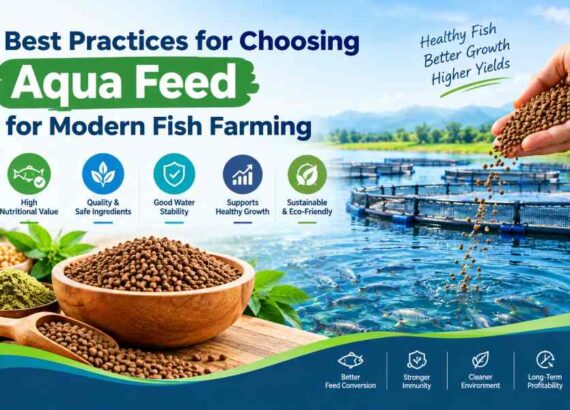
Choosing the aqua feed begins with understanding the nutritional requirements of the fish being cultivated. Farmers should consider species, average fish weight, growth stage, stocking density, water conditions and production objectives before selecting a feed. For example Pangasius feed, Tilapia feed and carp fish feed may differ in their protein levels, energy content, pellet size and other nutritional characteristics. Matching feed specifications to the target species helps ensure that fish receive nutrition throughout their growth cycle.
Pellet quality is another factor considering. Manufactured pellets should have consistent size, suitable water stability and characteristics appropriate for the species and feeding method. Floating fish feed can make feeding activity easier to observe because farmers can monitor how quickly fish consume the pellets. This visibility may help identify overfeeding. Adjust feed quantities. However floating feed is not automatically the choice for every species or farming system. Feed type should be selected according to the feeding habits of the fish, pond conditions and the recommendations provided by an aquaculture professional.
Farmers should also evaluate the composition and quality assurance practices of a fish feed manufacturer. Reliable feed production involves raw materials, balanced formulations, controlled processing and consistent quality checks. Ingredients should be. Stored safely to prevent contamination, deterioration and nutrient loss. Farmers should examine product information, manufacturing dates, storage instructions. Recommended feeding guidelines before using a feed product. Purchasing from a fish feed company can help farmers maintain greater consistency in their feeding programmes.
Responsible feeding management is equally important. Of following a fixed feeding quantity throughout the production cycle farmers should adjust feed according to fish biomass, growth rate, appetite and environmental conditions. Regular sampling can help estimate fish weight and determine whether feeding quantities need to change. During periods of appetite, poor water quality or reduced oxygen availability feeding practices may require adjustment to avoid unnecessary waste. Maintaining records of feed consumption, fish growth, mortality and water conditions can help farmers make better decisions over time.
Sustainable aquaculture also benefits from combining feed selection with broader pond management practices. Appropriate stocking density, aeration, regular water-quality monitoring, disease prevention and responsible waste management all contribute to healthier farming conditions. Even quality eco-friendly fish feed cannot compensate for overcrowded ponds, poor water management or inappropriate feeding practices. Sustainability is most effective when nutrition and farm management work together.
For fish farmers in India working with an aqua feed manufacturer can help simplify feed selection and improve consistency. Happy Feeds aims to serve the aquaculture sector by emphasizing the importance of fish nutrition and quality feed solutions. Farmers can explore feed options for their farming requirements and consider how feed quality, feeding efficiency and responsible management can contribute to their production goals. By making decisions aquaculture businesses can work toward improved fish growth, better resource utilization and more environmentally responsible production.
Conclusion
Sustainable aquaculture is essential for meeting the growing demand, for fish while protecting water resources and improving the long-term viability of fish farming. Eco-friendly fish feed supports this objective by encouraging nutrient utilization, responsible ingredient sourcing, reduced feed wastage and better farm management. When combined with stocking practices, regular water-quality monitoring and species-specific nutrition quality aqua feed can help farmers improve productivity and manage operating costs more effectively.
For fish farmers sustainability should be seen as something that keeps going instead of just one change in how they feed the fish. Picking the fish feed watching how well the fish turn food into growth making sure they aren’t given too much to eat and keeping the water in the pond clean can bring real benefits during the whole time the fish are growing. As feed gets better and farming methods become more responsible the fish farming industry can work toward using resources in the future. Happy Feeds knows how important good fish food is for helping fish farming work and pushing for more fish farming that is good for the environment across India.
Frequently Asked Questions (FAQs)
- What is sustainable aquaculture?
Sustainable aquaculture is the way of raising fish and other water animals while taking care of the resources used keeping the water clean making sure the fish stay healthy and cutting down on effects on the environment. It uses feeding the right number of fish in the pond and smart ways to run the farm to keep producing for a long time.
- How does eco-friendly fish feed help fish farming?
Eco-friendly fish feed can help fish farming be more sustainable by making sure the fish use the food well cutting down on some ingredients and helping to reduce leftover food. When it is made the way for the type of fish it can help the fish grow better and use resources in a better way.
- Can sustainable fish feed the costs of fish farming?
Sustainable fish feed might help costs if it gives the fish the right food and helps them grow more efficiently.. The actual savings depend on how much the feed costs how good the ingredients are, the type of fish how they are fed and the conditions of the farm. Farmers should look at the cost of feeding compared to how well the fish grow instead of just looking at the price.
- What kind of fish feed works best for Pangasius, Tilapia and carp?
The best feed depends on the type of fish how big they are, what stage they are in and the conditions where they are raised. Pangasius, Tilapia and Indian major carps need nutrition so farmers should pick feed that is right for each type of fish and has the right levels of nutrients and size of pellets. Talking to a fish farming expert can help find the choice.
- How can fish farmers make fish farming better for the environment?
Fish farmers can make their work better for the environment by picking food that has the mix of nutrients not giving too much to eat checking how well the fish use the food keeping the water clean using the right number of fish in the pond and keeping good records. Choosing feed suppliers and taking care of the fishs health and the pond can help make the whole process better, for the planet.
Thanks for reading
……………………………………………………………………………………………………………………………………………….
Click here to read this: How to Choose the Right Floating Fish Feed
Visit our product page to see all products: Click here to visit
Need help choosing feed? Use our Free Feed Calculator
Visit: Dust Fish Feed Products