
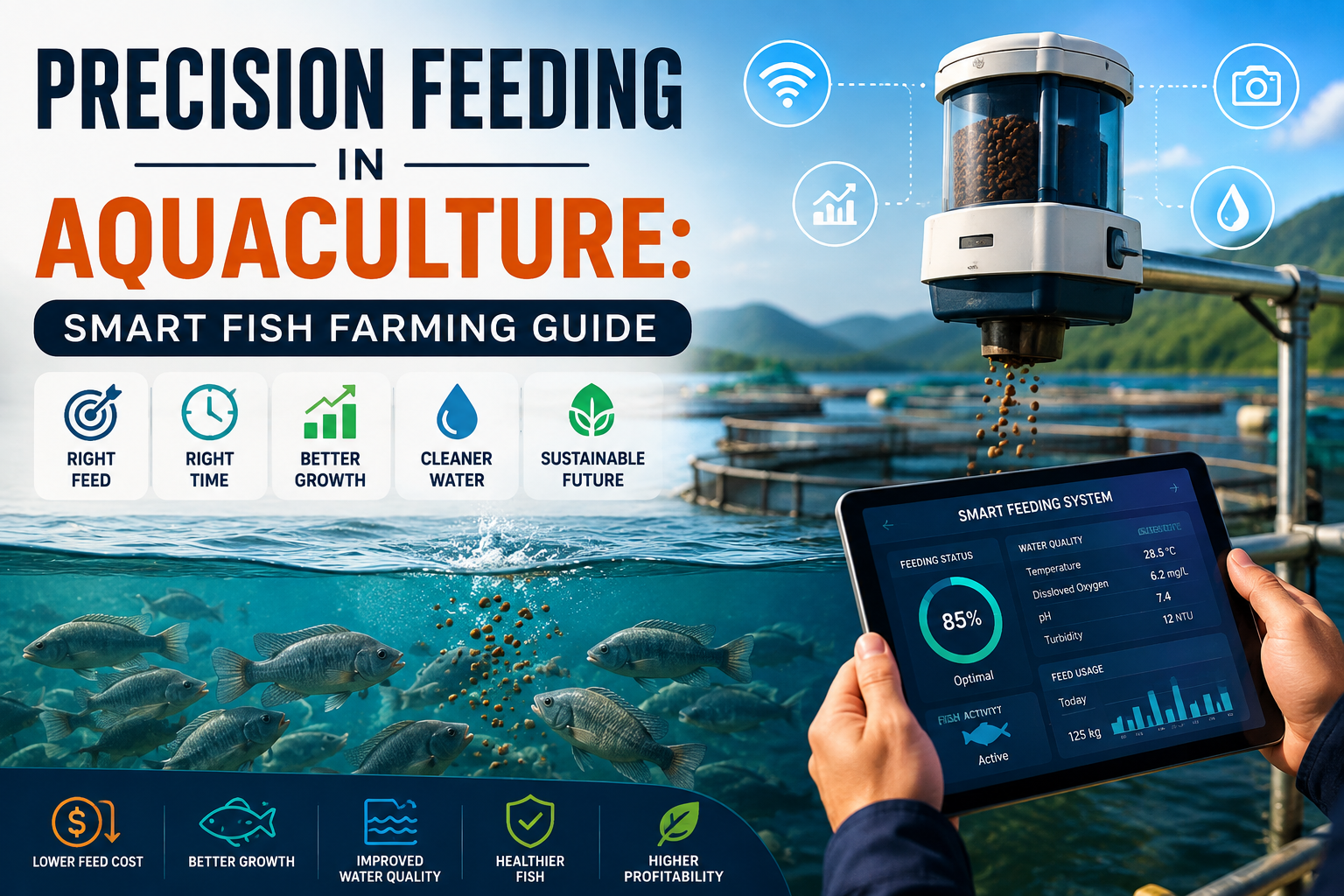
Aquaculture has become one of the fastest-growing food production industries worldwide. As the demand for fish and seafood continues to rise, fish farmers are under increasing pressure to improve productivity while maintaining sustainability. One of the highest operational costs in aquaculture is fish feed, accounting for nearly 50–70% of total production expenses.Traditional feeding methods often result in overfeeding or underfeeding, leading to feed waste, poor water quality, slower fish growth, and reduced profits. To overcome these challenges, modern fish farms are adopting Precision Feeding in Aquaculture.Precision feeding uses advanced technologies such as sensors, artificial intelligence (AI), machine learning, cameras, automated feeders, and real-time monitoring systems to provide the right amount of feed at the right time. This smart approach maximises fish growth, minimises waste, and improves overall farm efficiency.
In this guide, you’ll learn how precision feeding works, its benefits, technologies involved, implementation strategies, challenges, and why it represents the future of sustainable aquaculture.
What is Precision Feeding in Aquaculture?
Precision feeding is a technology-driven feeding strategy that delivers the exact amount of feed required by fish based on their:
Species
Size
Age
Growth stage
Appetite
Water temperature
Dissolved oxygen
Fish behavior
Feeding activity
Environmental conditions
Instead of relying on fixed feeding schedules, precision feeding continuously adjusts feed delivery according to real-time data collected from the farm.
The goal is simple:
Maximize fish growth
Reduce feed waste
Improve feed conversion ratio (FCR)
Lower production costs
Protect water quality
Why Precision Feeding Matters
Feed represents the largest investment in fish farming. Even a small reduction in feed waste can significantly increase profitability.
Common problems with conventional feeding include:
Overfeeding
Underfeeding
Uneven fish growth
Increased disease risk
Poor water quality
Higher production costs
Precision feeding solves these issues through data-driven decision-making.
How Precision Feeding Works
Modern precision feeding combines several technologies into one integrated system.
- Smart Sensors
Sensors continuously monitor:
Water temperature
Oxygen levels
pH
Salinity
Water movement
These factors directly influence fish appetite.
- Underwater Cameras
High-resolution cameras monitor fish behaviour in real time.
The system detects:
Feeding speed
Swimming activity
Fish density
Appetite
Leftover pellets
When fish stop eating, the feeder automatically slows or stops.
- AI-Based Decision Making
Artificial Intelligence analyses:
Historical feeding data
Weather conditions
Growth patterns
Fish behavior
Environmental changes
The AI predicts the ideal feeding schedule for maximum growth.
- Automated Feeders
Instead of manual feeding, automated feeders release feed according to AI recommendations.
Advantages include:
Consistent feeding
Reduced labor
Better timing
Less waste
- Cloud Monitoring
Modern farms allow managers to monitor feeding through mobile apps or cloud dashboards.
Farmers can:
Track feed usage
Monitor fish performance
Receive alerts
Adjust feeding remotely
Benefits of Precision Feeding
- Reduced Feed Waste
Feeding only what fish actually consume minimises uneaten pellets.
Benefits include:
Lower feed costs
Cleaner ponds
Reduced pollution
- Faster Fish Growth
Proper nutrition at the right time leads to:
Better weight gain
Uniform growth
Shorter production cycles
- Improved Feed Conversion Ratio (FCR)
FCR measures how efficiently fish convert feed into body weight.
Lower FCR means:
Better efficiency
Lower production costs
Higher profits
- Better Water Quality
Uneaten feed decomposes and releases harmful compounds.
Precision feeding reduces:
Ammonia
Nitrite
Organic waste
Oxygen depletion
Healthier water supports healthier fish.
- Lower Disease Risk
Good water quality decreases stress and disease outbreaks.
Healthy fish require:
Fewer medications
Lower treatment costs
Better survival rates
- Increased Farm Profitability
Farmers save money through:
Reduced feed consumption
Faster harvests
Better fish quality
Higher survival rates
Overall profitability improves significantly.
Technologies Used in Precision Feeding
Modern aquaculture relies on advanced tools including:
Artificial Intelligence (AI)
AI predicts feeding requirements using historical and real-time data.
Machine Learning
Algorithms continuously improve feeding recommendations based on farm performance.
Internet of Things (IoT)
Connected sensors collect and transmit environmental data instantly.
Computer Vision
Cameras analyse fish behaviour automatically.
Automated Feeding Systems
Programmable feeders distribute feed with high accuracy.
Drone Monitoring
Some large farms use drones for pond inspections and management.
Big Data Analytics
Massive datasets help optimise production over multiple farming cycles.
Species That Benefit from Precision Feeding
Precision feeding works well for numerous aquaculture species, including:
Tilapia
Pangasius
Rohu
Catla
Common Carp
Shrimp
Atlantic Salmon
Rainbow Trout
Seabass
Barramundi
Each species has different feeding behaviours, making customised feeding essential.
Precision Feeding and Sustainability
Sustainability is becoming increasingly important in aquaculture.
Precision feeding contributes by:
Conserving feed resources
Reducing environmental pollution
Lowering carbon emissions
Improving resource efficiency
Supporting responsible fish farming
This aligns with global sustainable aquaculture practices.
Challenges of Precision Feeding
Despite its benefits, implementation can present some challenges.
High Initial Investment
Advanced equipment requires upfront capital.
Technical Knowledge
Farm operators need training to use smart technologies effectively.
Internet Connectivity
Cloud-based systems require stable internet access.
Equipment Maintenance
Sensors and cameras need regular calibration and maintenance.
However, long-term savings generally outweigh these initial challenges.
Best Practices for Successful Precision Feeding
To maximise results:
Regularly calibrate sensors.
Monitor water quality daily.
Use high-quality fish feed.
Analyse feeding reports frequently.
Maintain automated feeders.
Train farm staff.
Monitor fish health consistently.
Adjust feeding schedules seasonally.
Integrate AI recommendations with farmer observations.
Keep accurate production records.
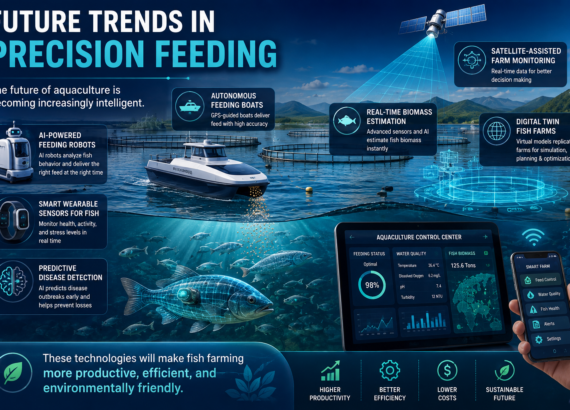
Future Trends in Precision Feeding
The future of aquaculture is becoming increasingly intelligent.
Emerging innovations include:
AI-powered feeding robots
Autonomous feeding boats
Digital twin fish farms
Real-time biomass estimation
Satellite-assisted farm monitoring
Predictive disease detection
Smart wearable sensors for fish
Fully autonomous aquaculture systems
These technologies will make fish farming more productive, efficient, and environmentally friendly.
Conclusion
Precision Feeding in Aquaculture is transforming the way fish farms operate by replacing guesswork with data-driven decision-making. Through AI, IoT sensors, automated feeders, and real-time monitoring, farmers can optimise feed usage, improve fish growth, reduce environmental impact, and increase profitability.
As technology continues to evolve, precision feeding will become an essential component of modern aquaculture. Farms that adopt these smart feeding systems today will be better positioned to meet growing seafood demand while maintaining sustainable and cost-effective production practices. Investing in precision feeding is not just about improving efficiency—it’s about building a resilient and future-ready aquaculture industry.
Frequently Asked Questions (FAQs)
- What is precision feeding in aquaculture?
Precision feeding is a smart feeding method that uses AI, sensors, and automated systems to provide fish with the right amount of feed based on real-time environmental and behavioural data.
- How does precision feeding reduce feed costs?
It prevents overfeeding by delivering only the amount of feed fish can consume, reducing waste and improving feed efficiency.
- Which fish species can benefit from precision feeding?
Species such as tilapia, shrimp, salmon, carp, trout, seabass, pangasius, and barramundi can all benefit from precision feeding systems.
- Is precision feeding suitable for small fish farms?
Yes. While advanced systems require investment, scalable and affordable solutions are increasingly available, making precision feeding practical for small and medium-sized farms.
- What technologies are used in precision feeding?
Common technologies include AI, IoT sensors, underwater cameras, automated feeders, cloud-based monitoring platforms, computer vision, and machine learning algorithms.
Thanks for reading
……………………………………………………………………………………………………………………………………………….
Click here to read this: How to Choose the Right Floating Fish Feed
Visit our product page to see all products: Click here to visit
Need help choosing feed? Use our Free Feed Calculator
Visit: Dust Fish Feed Products