
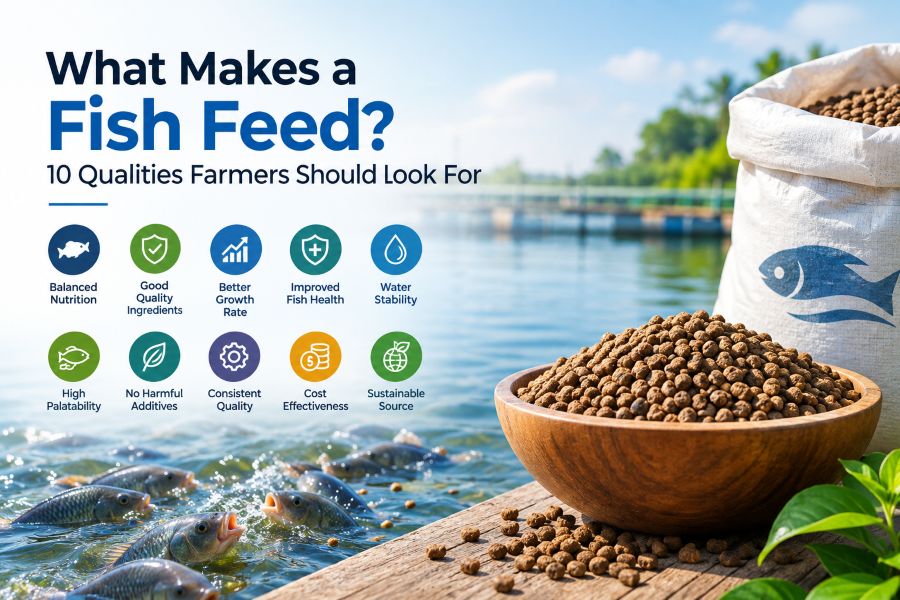
Choosing the feed is one of the most important decisions in successful aquaculture. Fish need a supply of protein, energy, fats, vitamins, minerals and other nutrients to support healthy growth and efficient production.. Not every feed product offers the same nutritional value, pellet quality, digestibility or water stability. For farmers knowing what makes a good feed can help improve feeding efficiency and reduce waste. A quality fish feed should be made according to the needs of the fish species the growth stage and the farming conditions. It should also have the pellet size, good water stability, proper buoyancy, strong palatability and consistent quality. FAO guidance points out that feed formulation and processing can impact availability, texture, water stability and buoyancy—factors that all affect how well fish eat and grow.
For farmers searching for a fish feed company in India understanding these qualities makes it easier to compare products and pick the best feed for their farming setup.
1. Balanced Nutrition and High-Quality Ingredients
The first thing a good fish feed must have is nutrition. Fish need nutrients in the amounts, not just a high amount of one nutrient. Protein is especially important for tissue growth and development. Fats and carbohydrates help provide energy. Vitamins and minerals support body functions and overall fish health.
A made feed should deliver nutrients based on the species and stage of the fish. The needs of fingerlings differ from those of fast-growing fish or fish ready for market. So farmers should match feed to the size and development stage of their fish. FAO sources say that diets must supply nutrients and energy in proper amounts for growth, reproduction, health and well-being.
This is especially true when choosing feeds like fish feed for tilapia, pangasius feed or carp fish feed. A feed made specifically for that species can offer a nutritional match than a general-purpose feed.
2. Good Digestibility and Efficient Nutrient Utilization
The important quality is digestibility. Even if fish eat the feed the real benefit depends on how they can break it down and use the nutrients. High-quality ingredients and proper processing help make nutrients more available to the fish.
Good digestibility helps improve feed conversion. The feed conversion ratio depends on things—diet quality, feeding methods, fish size, water temperature and oxygen levels.
For farmers this means that the cheapest feed might not be the most cost-effective if the fish cannot use it well. A trustworthy Indian fish feed supplier should give details about the feed and recommend feeding practices based on species and fish size.
3. Palatability
A good feed must be something the fish want to eat. Palatability affects how fast fish respond to the feed and how consistently they eat it. If fish show interest they may eat less and uneaten feed can build up in the water.
Good feed formulations take into account ingredient choice, taste, smell, texture and the natural feeding habits of the fish. Farmers should watch how fish react when a new feed is introduced, not just rely on how the feed looks.
4. Appropriate Pellet Size and Uniformity
Pellet size is another factor. Fish should be able to eat the pellets based on their mouth size and growth stage. Pellets that are too big can be hard for small fish to consume. Pellets that are too small may not be practical for fish.
Uniformity matters too. FAO guidelines say that consistent pellet size helps ensure each pellet delivers an amount of nutrients. It also shows the manufacturer has control over the production process.
Quality fish feed pellets should have dimensions and come in sizes that fit different fish growth stages.
5. Strong Water Stability
Water stability is one of the important physical traits of aquaculture feed. Pellets must stay together enough for fish to eat them without falling apart or sinking too fast.
When pellets break down quickly nutrients escape into the water before the fish can eat them. This leads to nutrient loss. Can harm water quality. Research found through FAO AGRIS also stresses the importance of pellet strength and reducing nutrient release.
Farmers should choose fish feed pellets that hold their shape during the feeding period.
6. Floating or Sinking Characteristics
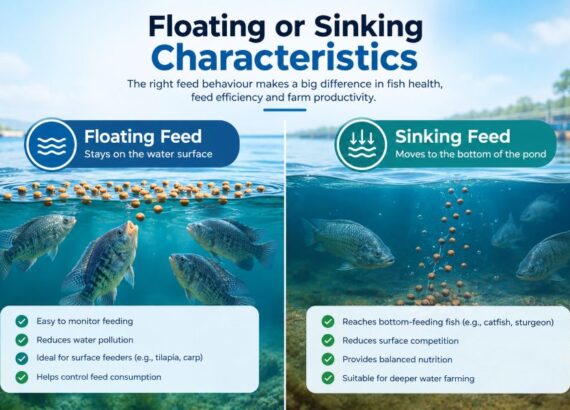
Different fish and farming systems need different pellet behavior. Floating fish feed India products are useful when farmers want to watch feeding activity at the surface. Floating feed makes it easier to see if fish are eating. If there is leftover feed.
For species or systems that use sinking or sinking feed the product should be made accordingly. The right buoyancy depends on fish behavior, pond conditions and feeding habits—not all farms need the type.
7. Dust and Minimal Pellet Breakage
Another sign of good feed quality is physical strength. Much dust, fines or broken pellets increases waste during transport, storage and feeding. It can also make it harder to measure how much feed is being used.
Good manufacturing and handling help keep pellets from production to the farm. Farmers should check bags for powder or broken pieces before buying in large amounts.
8. Moisture and Good Storage Stability
Moisture content directly affects how long feed can be stored. Much moisture can lead to mold and spoilage if storage is not done correctly. FAO guidance says dry feeds can be stored longer if kept in the conditions but high moisture creates storage problems.
Farmers should buy feed from a fish feed company in India check packaging and production details and store bags in a clean dry cool place away from moisture.
9. Consistent Quality from Batch to Batch
Consistency is essential in commercial fish farming. Farmers need feed that performs the way every time. Changes in pellet size, texture, moisture or ingredients can make feeding more difficult.
A professional aqua feed India manufacturer should use quality-control steps throughout the process—from ingredient selection to formulation, processing, packaging and storage. Consistency gives farmers confidence when planning their feeding routines.
10. Species- and Stage-Specific Formulation
Finally good feed must match the fish being raised. Different species have nutritional needs and feeding habits. Nutritional requirements also change as fish grow.
FAO materials say that multiple diets may be needed because protein and energy needs shift during growth. Whether farmers need fish feed for tilapia, pangasius feed, IMC feed or carp fish feed using a formulation made for that species and growth stage is key to feed management.
Conclusion
Good fish feed is more than just something fish will eat. It should combine nutrition, digestibility, palatability, the right pellet size, water stability, proper buoyancy, low dust, good moisture control, batch consistency and species-specific formulation. These qualities help farmers manage feeding and reduce unnecessary losses.
For farmers looking for a fish feed company in India Happy Feeds focuses on high-quality aquaculture nutrition and practical feed solutions made for fish farming needs. Picking the right fish feed pellets and using them based on species, size, stocking density and farming conditions can make feeding management more efficient.
FAQs
- What are the important qualities of good fish feed?
Important qualities include nutrition, good digestibility, palatability, appropriate pellet size, water stability, suitable buoyancy, low dust, proper moisture, consistent quality and species-specific formulation.
- Why is water stability important in fish feed?
Water-stable pellets stay intact enough for fish to eat them. This helps reduce nutrient loss and keeps water quality better by preventing feed from breaking down too fast.
- Is floating fish feed, for all fish?
Not always. Floating, slow-sinking or sinking feed should be chosen based on the fish species and the farming system. Floating feed can help farmers see how much fish are eating.
- How should farmers choose fish feed pellets?
Farmers should look at the fish species, growth stage, pellet size, nutritional content, palatability, water stability. Recommended feeding conditions before choosing fish feed pellets.
- Why is species-specific fish feed important?
Different fish species and growth stages have nutritional and feeding needs. Species-specific feeds help farmers give the nutrients for their farming setup.
Thanks for reading
……………………………………………………………………………………………………………………………………………….
Click here to read this: How to Choose the Right Floating Fish Feed
Visit our product page to see all products: Click here to visit
Need help choosing feed? Use our Free Feed Calculator
Visit: Dust Fish Feed Products